Tuesday, March 15, 2016

Talmud Circle 6: A Separation from the Land

Rashi (1040-1105)/artist unknown to me
We met on a rainy Sunday morning, March 11, 2016. Daylight savings. The bagel to talmudist ratio was 5:1 on this day. There was great homemade coffeecake too!  But the coffee didn't last.

Peretz lead us in an extended discussion on the creation of Talmud and how it has been assembled, supplemented and revised over the centuries. The Talmud reading, starting with the mnemonic that appears in the middle of page 215, through to the middle of p. 216 of the Steinsaltz Talmud Bavli, Berakhot, entailed three compact stories from rabbi Elazar that illustrate the separation of the people of Israel from the city of Jerusalem and the land. These three stories are at the heart of the transition from Israelite to Jew, as Michael Satlow puts it in his podcast series. No longer is God accessed through sacrificial offerings in the city of Jerusalem: in creating Judaism the rabbis have placed the emphasis on private direct dialogue between individual Jews and God, using Hannah as a model.

A Brief History of Manuscripts 


Peretz asked us to envision the desk of Maimonedes (1135-1204). A big wooden table, covered with many manuscripts. Candelabra, perhaps? Maimonides lived two and a half centuries before Gutenberg developed his printing press.  In Maimonedes's time all manuscripts were painstakingly copied by hand. This is a slow process. They say it takes a sofer (scribe) 18 months to handcopy a Sefer Torah (the five books of Moses). It's as labor intensive as creating a Persian carpet, and as expensive. 

Most manuscripts used by Jewish scholars through the centuries have been lost. In addition to the vagaries of time, many were burnt by the Catholic church, by crusades, by the inquisition. Others were lost during pogroms in the East, during the Shoa, and in unrest in the Middle East following the end of French and British colonial rule. Some beautiful manuscripts made their way to the Vatican library. The Library of Congress in Washington D.C. has one. 

The Aleppo Codex  was considered the oldest complete manuscript of the Tanakh (Hebrew bible) created by Jewish scribe scholars (Masoretes) working in Jerusalem, Tiberias, and Babylonia in the sixth through 10th centuries C.E. The Masoretes developed a common system of pronunciation, grammatical guides, diacritical notations, including a vowel notation system.  The ben Asher family was largely responsible for the preservation of the Masoretic texts. Aharon Moshe ben Asher in around 930 CE produced a full manuscript of the entire bible which was preserved for a thousand years in various centers of Jewish learning in the Middle East: Jerusalem, Tiberias, Alexandria, and Aleppo. Maimonedes examined it and pronounced it good and helped establish its authority. 

In 1947, in the wake of the UN declaration of the division of Mandate Palestine, the Aleppo Codex was damaged in rioting that took place in the city of Aleppo. Much of the manuscript was hidden and, in 1958, smuggled out of Syria to Jerusalem. But not all of it. The first part of the manuscript (the Pentateuch) was heavily damaged with only the last eleven pages surviving. According to Aleppocodex.org: "The final pages of the Aleppo Codex are also missing, including part of the Song of Songs, and all of Ecclesiastes, Lamentations, Esther, Daniel, Ezra, and Nehemiah. In the rest of the books of the prophets, some pages are missing. In all, the Aleppo Codex originally had 487 pages." According the a lengthy New York Times article in July 2012, more than 200 pages (40% of the total) are missing. 

We make do with what manuscripts we have and the tradition carries on....

The oldest known complete Torah scroll is a sheepskin manuscript created in 1155-1225 according to carbon dating, and is kept in a library at the University of Bologna. 
Prof. Mauro Perani, University of Bologna
w/. oldest Sheepskin Torah scroll, created in late 12th cent. 
Mishna, as we know, is a collection of manuscripts that forms the foundation of Talmud. To recap from our class on November 1, 2015, it was the first major book of Rabbinic literature redacted by the school of Rabbi Judah HaNasi before his death in ~217 C.E., and it reflects the views and works of a group of rabbis called the Tannaim. (Tannaim, we recall, is an Aramaic word related to Hebrew "Shana", meaning to "repeat" or "recite"; the Tannaim were active approximately 10-210 C.E.) 

The Amoraim, the rabbis that followed Judah HaNasi issued more manuscripts. They built upon the foundation of the Mishna with a lot of manuscripts that by about 500 C.E.  were gathered in the Gemara. Today we have the closed product of Mishna and Gemara, the Babylonian Talmud--we don't have snapshots along the way. [Rabbinic notes and manuscripts from the Galilee area were bound into the less discussed and used Jerusalem Talmud, ca 350-400 CE]

Of course the Talmudic tradition of writing manuscripts and commentary did not end with the closing of the Gemara. Manuscripts continued to multiply apace. We especially know of famous Jewish scholars in the 12th to 14th centuries like Rashi (1040-1105) and Maimonides (1135-1204). But there were thousands of them, as the creators of the Aleppo Codex and the Bologna scroll (above) attest.  

Maimonedes attempted to impose some order with his Mishneh Torah. The Mishneh Torah, of course, as well as the later refinement of the Shulkhan Arukh (rabbi Joseph Caro 16th century) were intended as the guide for daily life. 
An old copy of the Mishneh Torah


From Manuscripts to Printed Talmud


Between 1520 and 1523 Daniel Bomberg (d. ~1549) took the manuscript commentaries of the Babylonian Talmud and printed them in a new edition of the Talmud as we know it today. Notably he included some manuscript commentaries generated in the 12th to 14th centuries. Bomberg was a Christian born and raised in Antwerp but he settled in Venice where he established his printing press and published two complete editions of the Babylonian Talmud. He prominently placed the Mishna and Gemara (as they were closed in the Babylonian Talmud) in the center (and dominant part) of the page, and surrounded this with commentaries (Tosafot) from prominent rabbis of the 12th to the 14th centuries (e.g. Rashi, Rabbi Hananel ben Hushiel). 

Three and a half centuries later (in the 1870's-1880's) publishers in Vilna, Lithuania gleaned and improved the Bomberg. The Vilna edition of the Talmud became standard and was widely recognized as better than other competing editions (such as, e.g., the Vesheva, Kiev, Bialystock, and other editions....). 

A story: When a student, rabbi Peretz encountered Ben Zion Wacholder. Wacholder was born in 1924 in a shtetl south of Warsaw, studied in Yeshivot in Warsaw and Vilna, and was recognized as a promising young scholar before the outbreak of war in 1939. He survived the war in Poland by living under an assumed name. Moving to the U.S. after the war, he received rabbinic ordination from Yeshiva University (New York) in 1951, and a PhD in history from UCLA in 1960.  He became a renowned expert on the origins and development of Talmudic Judaism and played a key role in enhancing scholars’s access to the Dead Sea Scrolls. Blessed with a photographic memory, Wacholder knew his sources by heart. By the time rabbi Peretz encountered him, he was blind from macular degeneration. Sharp as ever, lack of sight made him more imposing still. When he assigned a particular section of Talmud for discussion in class the next day one had better be prepared. Peretz recalled this one assignment. The students dutifully found the assigned section of Talmud in the library, made copies, and did their reading. But in class Wacholder was chagrined: "What are you reading?" he said. The students were taken aback. They cited the section they had so diligently prepared. "Which Talmud? " asked Wacholder. "Was it blue?" The blue Talmud in the library, it became apparent, was the Vesheva edition with a different lay-out and pagination.  "I don't like that one," said Wacholder, who knew the Vilna edition by heart. 

The point is, from manuscripts to printed volumes, there is no definitive edition of the Talmud.  The Vilna Talmud won out as the standard of the printed editions because it was recognized as an improvement on the Bomberg Talmud. After World War II it took on added significance by virtue of the fact that it survived the Holocaust.

Issues of Interpretation and Translation


When Steinsaltz began his project of reissuing the Talmud in modern Hebrew with punctuation and vowels and exposition in 1965, his project was greeted with skepticism in some circles. By imposing his view as to what the correct vowels might be for a word, where clauses end, and where sentences end, Steinsaltz is performing an interpretive act. When he goes further and tells us what assumed knowledge might be implied in the shorthand that is found in Talmudic manuscripts, this too is a matter of interpretation.... and hence debate. 

Steinsaltz makes the process transparent by including the "original text"--although there really is no truly original text--for comparison. Not that this helps those of us who are not fluent in both biblical and modern Hebrew. But still we get to follow along in class.

The format of the Talmud we see at the back of the Steinsaltz Talmud [e.g. Berakhot p. 64--which corresponds to where we are currently studying, pp. 215-216 for the English] derives from the Bomberg-Vilna editions. The traditional commentaries from the Bomberg and he Vilna are preserved in the right hand margins. Steinsaltz adds some of his own along the left margin. 

In our English translation, of course, the lay-out is significantly modified, and gaps in logic and "assumed knowledge" are filled in. The formatting is changed to make it readable and accessible to modern audiences who do not have decades of Yeshiva training. Like Tyndale's translation of the Vulgate bible, it stirred emotions. But so far--we think--no one has suggested Steinsaltz should be strangled at the stake and burned.  

The Steinsaltz makes no claim to perfection.  It is part and parcel of the living tradition. Just like the Vilna Talmud advanced the Bomberg edition, Steinsaltz and his team of translators (Dr. Sheldon Berger is the head of English translation) are carrying the tradition forward. And by engaging with the text, we are too. It is not fundamentally different from what happened when Maxwell House coffee tried to convert Eastern European Jewish immigrants to drink coffee by creating and giving away the "Maxwell House Haggadah." Ultimately, as David Hartman said per Peretz, the essence of Talmud is not the document in front of us but the community that surrounds the document. 

Take the mnemonic device before the break in the middle of p. 215 of the Steinsaltz Talmud Bavli, Berakhot (end of Perek V:32a): "Deeds, charity, offering, priest, fast, shoe, iron." The mnemonic introduces three teachings by rabbi Elazar. The mnemonic is not original to Rabbi Elazar (1st century CE, one of the second generation of Tannaim); it was inserted later as a memory aid. After all, not everyone has a photographic memory like Wacholder. The word "shoe" seems out of place here because it does not appear in the text that follows--the text to be memorized. The word that appears is "lock" ("Since the day the Temple was destroyed the gates of prayer were locked; though I plead and call out, He shuts out my prayer")  Is "shoe" a mistake, or is it intentional? What's going on? Peretz shared with us the sleuthing of Ron Sires, who participates in the Downtown Talmud Circle: the word for "shoe," but also for "lock," is Na'al. There is a connection between the two meanings of the word in that shoes in the first century CE were fastened ("locked") with a strap. Just like the velcro strap on Peretz's Tivas. Says Ron Sires: "It does appear that the double meaning of na'al as both 'shoe' and 'lock' is one that the rabbis knew and played around with. It may be that the mnemonic used a form with the meaning of 'shoe' while the cited passage used the meaning of 'lock.' Some of the references I've found indicates that, as you said, the common meaning of 'fastening' is the link between the two." So mistake? or playful use of the word "shoe." Reasonable minds can differ. 

More about this mnemonic on p. 215: Peretz directed us to the fact that, in the original (at the bottom of page 63), the mnemonic is in parenthesis. Why in parenthesis? Because the mnemonic does not appear in the Vilna Talmud. Apparently Steinsaltz saw it in some other Talmud (maybe in Peretz's blue edition?) and he added it here... but set it apart with parenthesis.  In the English translation on page 215, of course, the mnemonic is firmly ensconced: no parenthesis, and no notation of where it came from. 

Aside 1. Dispute and disagreement and interpretation is of the essence to the tradition, says Peretz. The Judaism of the Talmud is not about biblioidolatry.  A possible exception is the Sefer Torah, which is used as a performance object. It's not like when the Catholic church thought it owned the bible. Talmud belongs to all and all may engage in it.  For the uninitiated like me, of course, this is more true now that we have translations in English, with Steinsaltz filling in logic gaps and explaining underlying assumptions, and Lehrhaus Judaica providing expert guidance.  Even so...., I am always surprised in class how much is hidden below the surface...; we still need a guiding hand. Before Steinsaltz, however, it seems clear that Talmud was strictly for the initiate.  

Aside 2. Peretz also said Talmud is not like the Koran "where you take your life into your hands when you question any part of the text." That is true, of course, if we listen to political campaigns or to noises made by raping, murdering thugs in Syria, and Iraq...., but I don't think it's true in a theological sense.

Roberta Kwall in her book The Myth of the Cultural Jew observed (p. 21): 
"Sacred texts reveal a multiplicity of meanings on their face. There is no fixed meaning from the get go. There is a multiplicity of views as to God, sin, retribution, love, justice, etc. Language of the original has multivalent quality in that its verb roots often support multiple meanings through seven types of verb construction known as baynim. Hebrew lends itself to different ideas within a single expression or word. Different people bring different interpretations. Dispute is part of the tradition."
This holds true for Islam as well. In reading about Islamic law, e.g. Wael Hallaq's An Introduction to Islamic Law (free .pdf version) they have a legal tradition of interpretation very similar to Halakhah. 

Aside 3. The six orders of the Mishna (Zera'im, Mo'ed, Nashim, Nezikin, Kodashim, and Tohorot) or in English (Seeds, Festival, Women, Damages, Holy Things, and Purities) also serve as a mnemonic to help sort the 63 tractate that are found there.  Similarly, the order of the Passover meal can be seen as a mnemonic device. 

Aside 4. "Mazel-tov" "Simen-tov" signifies all will be well. Used for celebration, as in marking life-stages: births, bar-mitzvahs, weddings. Something good is coming....

How great is Prayer? Let me count the ways: Deeds--Charity--Offering--Priest--Fast--Shoe--Iron


So, finally, we get to the text of this lecture: the three discourses of Rabbi Elazar (and friends) on pp. 215-216.

1. "Deeds."  Rabbi Elazar said "prayer is greater than good deeds without prayer." He cites as evidence that Moses, who performed many good deeds for his people, nevertheless had to pray for the privilege of seeing the promised land. "Only through prayer" did God permit him to climb the mountain and see the land. We can pile up good deeds, but to get what we want, we need to pray also. This harkens back to Hannah again. We don't know about Hannah's good deeds. We know of her tribulations. But good deeds or no, it was through direct appeal to God--through prayer--that she was granted her son. 

2. "Charity." Rabbi Elazar says further that "a fast is greater than charity." He cites as evidence that fasting involves the whole body, our entire being; charity only involves our money (which may be trivial depending on our circumstances). Again we harken back to Hannah who "looked drunk" because she was all in. By praying with her full attention she did more than charity (offering sacrifice?) 

3. "Offering." Rabbi Elazar also said that "prayer is greater than sacrifices."  As evidence he quotes from Isaiah 1:11 ["What good to me is the multitude of your sacrifices? says the Lord; I have had enough of burnt offerings of rams and the fat of fed beasts; I do not delight in the blood of bulls, or of lambs, of he goats."]  The northern kingdom has fallen and is occupied by the Assyrians. Jerusalem and the kingdom of Judah is on dangerous ground. Isaiah rails against Judah's religious superficiality. A thousand years of sacrifice, "enough already!" says the Lord. Prayer is better. It is immaterial; it is from the essence of you, it is prolonged. I like it, says the Lord.

4. "Priest." Rabbi Elazar adds, citing Isaiah 1:15, "and when you (the priest) spread forth your hands, I will hide my eyes from you, even though you make many prayers, I will not listen, your hands are full of blood." No more of this sacrifice!  Rabbi Yohanan chimes in: "just like a priest who kills a person may not lift his hands in offering; a priest may not lift his hands to God bloody from sacrifice. 

5. "Shoe" (Ha, ha; they mean "lock"). Rabbi Elazar also said: "Since the day the Temple was destroyed the gates of prayer were locked.... Though I plead and call out, He shuts out my prayer. Yet, despite the fact that the gates of prayer were locked... the gates of tears were not." And we recall that it was the tears that opened the gates of prayer for Hannah in Shiloh. Private prayer. Lips moving mute silent prayer.  Although our prayers are locked out, and God does not hear, He does hear if our prayer is accompanied by tears. Elazar refers to destruction of the First Temple here, in 586 BCE. [Lamentations 3:8--"Though I call and cry for help, he shuts out my prayer; he has blocked my ways with hewn stones, he has made my paths crooked."] 

6. "Fast." And Rava cites to Lamentations 3:44: "Thou hast wrapped thyself with a cloud so that no prayer can pass through. Thou hast made us offscouring and refuse among the peoples." And Rava did not decree a fast on a cloudy day. Why fast if God's not going to listen to you anyway! 

7. "Iron." And Rabbi Elazar said: "Since the day the Temple was destroyed an iron wall separates Israel from their Father in heaven." He cites as evidence Ezekiel the prophet who is sent by God to speak to the people of Israel in exile, in God's voice. [Ezekiel 3:22-4:3] "And ... take a brick and lay it before you, and portray upon it... Jerusalem; and put siege works against it, and build a siege wall against it, and cast up a mound against it; set camps also against it, and plant battering rams against it round about. And take an iron plate, and place it as an iron wall between you and the city; and set your face toward it, and let it be in a state of siege, and press the siege against it. This is a sign for the house of Israel." 

So what are these three stories of rabbi Elazar? The first story ("Deeds/Charity") says prayer is essential; good deeds alone are not sufficient; it is superior to charity even. The second story ("Offering/Priest") establishes that the days of sacrifice are over. One thousand years was enough. From here on out it's prayer. The third story ("Shoe/Fast/Iron") deals with the destruction of the temple and the loss of Jerusalem. No longer are prayers heard through Jerusalem. An iron wall has descended between the people of Israel and the city. A cloud has descended over the city. No longer can prayers be heard through the clouds and the iron. 

Silent, fervent, private prayer.... like Hannah. With tears. That's the way to access God. 

We left off in the middle of page 216.  Our next class is on April 10, 2016.

Wednesday, February 24, 2016

Talmud Circle 5: A Drash with a Hollywood Ending

Our JCCSF Talmud Circle met on Sunday, February 21, 2015. Over bagels and lox we started off with an aside on identity politics. Thereafter we picked up with the second paragraph on p. 212 of the Steinsaltz Berakhot, and we covered everything to the middle of page 215 (end of Daf 32a).

The rabbis are still trying to understand the significance of (or is it make significant) the intense prayer of Hannah in Samuel I.

Aside 1:  From Bernie Sanders to Isaac Deutscher and Jon Stewart


When I entered the room people were discussing Bernie Sanders. Although Bernie Sanders is not the first Jew running for president (Arlen Specter and Joe Lieberman preceded him), he is the first to win a primary contest and the first to mount a credible campaign. But Sanders is down-playing his Jewish identity: he is the "son of a Polish immigrant" says a campaign ad. And he is not particularly embraced by the Jewish community as their champion. Despite Sanders having spent some months on Kibbutz Sha'ar HaAmakim in the Galilee in 1963, Hillary Clinton's pro-Israel bona fides are perceived as stronger than those of Sanders. 

But of course there's more to Judaism than Netanyahu and Israel. After all, the whole Hannah project that the rabbis are discussing in Berakhot 30-32 is all about establishing Judaism as a tradition independent of Eretz Israel. 

“People say [Sanders] looks like a prophet,” noted Rabbi Peretz Wolf-Prusan to Dan Pine in the J. 
“If you look at the [prophetic] Book of Amos, this country will be judged by how it treats its least able. [Sanders] is conducting a seminar in social economic justice with the American people. ....Everyone wants to vote for the nice Jewish boy, but prophets are annoying. They tell you things you don’t want to hear, and that’s what he’s doing. He’s not concerned about winning Jewish hearts and minds, but with saving the American people.”

Bernie Sanders, a secular prophet 

He's a "non-Jewish Jew" in the phrase coined by Isaac Deutscher, said Rabbi Peretz. Deutscher was a Jewish humanist:
He coined the expression "non-Jewish Jew" to apply to himself and other Jewish humanists. Deutscher ... had little time for specifically Jewish politics. In Warsaw, he joined the Communist Party, not the Jewish Bund, whose "Yiddishist" views he opposed.
His definition of his Jewishness was: "Religion? I am an atheist. Jewish nationalism? I am an internationalist. In neither sense am I therefore a Jew. I am, however, a Jew by force of my unconditional solidarity with the persecuted and exterminated. I am a Jew because I feel the pulse of Jewish history; because I should like to do all I can to assure the real, not spurious, security and self-respect of the Jews."
Like Freud, Einstein, Rosa Luxemburg, Jon Stewart, and Deutscher, Sanders is secular but identifies as Jewish and is acting in accordance with Jewish values. Like them he will be embraced as Jewish in hindsight. Like Simon and Garfunkel who provide the music in Bernie's ad above.

A Talmudic Drash with a Hollywood Ending


Every once in a while in Talmud, the rabbis insert a Drash, a story. Like a Lincoln speech, or an Emerson essay--it's meant to explain and persuade. These stories have a particular form, with an opening, a middle, and a closing.

They often have happy endings appended. Take the story of Job which has this inexplicably happy last paragraph.  Job 42:10-17 ["And the Lord restored the fortunes of Job...and .... gave Job twice as much as he had before."]  It makes no sense..., but there's a reason Hollywood favors happy endings.

Take a look at the end of Ecclesiastes--a depressing philosophical reflection--with a sudden upbeat ending. Ecclesiastes 12:9-13. It was added by later writers with the purpose of making the reader feel better.

The Yiddish version of Romeo and Juliette written by Ukrainian born Boris Tomashevsky (the grandfather of conductor Michael Tilson-Thomas) follows this tradition. In Tomashevsky's Yiddish version there is a happy ending ("meine Kindele!") It's a trick as old as Talmud.

Here (going back to Berakhot) the rabbis start their set piece--their Drash--in the third paragraph on page 212... and it continues right to the middle of p. 215.

Beginnings


The rabbis begin by turning from Hannah to Moses. "Moses also spoke impertinently toward God on High" notes Rabbi Elazar at the top of p. 212. He invokes Numbers 11:2 (the people were complaining in the desert and God became angry and Moses prayed to God and his anger subsided). And the words Moses used suggest "hurl" and "insult." This is not abstract prayer Moses is engaged in. It's personal. (Moses prayed not "to" [el] but "on" [al] the Lord; right up close, stepping on his toes). The rabbis play on the fact that the sounds are similar in Hebrew. 

It sets up the stories to follow. 

"Impertinence" implies a disparity of rank. Such prayer to the one of highest rank (God) entails Risk. Just ask Job. In Hannah's case, she was driven by great desperation to take on such risk. A hero is like everyone else, Peretz reminds us; heroes just go a few steps further... or are driven five minutes longer by exigent circumstances. 

Hannah, as we recall, prayed silently. Only in Hasidism does permission come to say it out loud like Tevye in Fiddler on the Roof. 

The moral of the stories in the Drash about to unfold are that Hannah and Moses are aligned in their manner of prayer: but Hannah is the model. [Moses is like Hannah, not the other way around] 

The sages from the school of Yannai introduce the Drash by referring to Moses at Sinai and the sin of the Golden Calf.  Moses returns from the mountain to find the people absorbed in idolatry. God is so upset he wants to destroy them. But Moses intercedes on their behalf. "No, don't do that!" he says, bringing explanation and evidence and arguments; "they behave as they do because of the gold and silver you lavished upon them, that's what caused them to build the golden calf."  
Golden calf with Egyptian God Yah symbol/
unknown derivation
Moses demonstrates how prayerful intercession is done. We instinctively know the three elements of his prayer: 1) a personal recrimination .... "You did...," "You promised...."  2) presentation of evidence of some verifiable harm, and 3) an expectation of restitution or repair.  

Middle


There follow a series of small stories (or analogies) meant to appeal to and understood metaphorically by different types of people: there is a rural story (about a loopy cow), an urban story (tempting a son with a brothel) and one appealing to authority (a king restrained in killing his son in anger by the presence of a guest). This is a common technique. 

We should trust that God will be susceptible to understanding our failings, suggest the stories: just like the farmer is understanding of his long limbed cow who kicks him because the farmer fed her lupines (which causes intoxication in cows); just like a father is understanding of his son when he realizes he may not have exercised best judgment in leaving his perfume anointed son with a purse of money around his neck on the steps of a brothel. 

And God's understanding may depend on our actions, suggest the rabbis. We must appeal to God with prayer just like a guest at the king's court  must appeal to the king to use restraint when he realizes it is only his presence that is restraining the king from killing a son in anger. Who would not speak up to calm such anger? And in the same manner Moses realized that it was up to him to intercede with God: "Moses grabbed the Holy One... as a person who grabs his friend by his garment would, and said before Him: ...I will not leave You be until You forgive and pardon them."  

We can learn from stories about the rich and famous realized the rabbis. Hannah and Moses, too.  Such stories hold our attention. It's like watching Downton Abbey, says Peretz.  

In their effort to change attitudes towards prayer, the rabbis are working to get us to think: "What else is it I have been told that is wrong?" It's like  the parable of the Good Samaritan (Luke 10:25-37) which strives to change attitudes toward "The Other." 

***

Aside 2: I note Steinsaltz refers (p. 212, para. 4) to "the beginning of Deuteronomy," but the first three chapters of Deuteronomy are Moses giving a historical overview to "all Israel beyond the Jordan in the wilderness."  Deuteronomy 4:12-19 relates God speaking to the people at Mt. Horeb and reiterates the prohibition of idol worship--but it does not discuss the sin of the golden calf or any type of prayerful appeal to God. Deuteronomy 5:1-27 is a recitation of the ten commandments and a statement of the covenant between God and the people to always fear God and to keep all his commandments. Not until Deuteronomy 9:8-22 do we get the story of the golden calf--but it is Moses recapping what happened in Exodus, and he's telling a revisionist tale. In Exodus 32 God says to Moses "leave me alone, that my wrath may burn hot against them and I may consume them; but of you I will make a great nation." Ex. 32:9-10. Then Moses "besought" the Lord, pointing out that the Egyptians might say God brought the Israelites out of Egypt with "evil intent." Ex. 32:12. And Moses reminds God of his covenant with Abraham, Isaac, and Israel. Ex. 32:13. In other words, Moses tries to shame and guilt trip God--and it works.  "And the Lord repented of the evil which he thought to do to his people," it says.  Ex. 32:14. But both God and Moses did not repent too much. A few verses later Moses decides to put down the rebellion by having the sons of Levi slaughter 3,000 with their swords. And the next day the Lord sends a plague upon the people. Exodus 32:35.  There's not a lot of restraint here. These facts are conveniently left out of the recitation in Deuteronomy 9. 

Aside 3: Another Midrash--When Moses sees the Israelites with the golden calf he breaks the tablets with the ten commandments that were inscribed by God. He breaks them out of love because he realizes that if he preserves the tablets they will wind up worshipping them as idols. When Moses returns sheepishly to God after having broken the tablets God says "I'll make you one like the first...," but this time Moses transcribes the commandments. God does not inscribe it with his own hand. 

Aside 4: And in prayer, of course, there is always doubt. "What do we really know?" Peretz reminded us of Abraham Heschel's observations that doubt leads to reflection, to evidence gathering, and as such it is the first step towards wisdom. See, e.g. Man is not Alone (1951) and God in Search of Man (1955). 

***

Conclusion: "Beseech" How?


"Moses beseeched before the Lord" (p. 213, para. 6). The word for "beseeched," vayahal, is subject to different interpretations. Rabbi Elazar suggests Moses prayed so fervently that he became ill from overexertion. Rava (c. 280-352 CE) said the word alludes to "nullification" of God's vow and that Moses's "beseeching" prayer "caused the Divine Attribute of Mercy to take effect upon them." Just like the guest standing up and rescuing the son from the king's wrath, Moses's prayer caused God to show mercy. Like the guest stood up to the king, Moses managed to convince God that it would be a sacrilege for God to destroy his people. 

Moses stood in prayer until he was overcome by ahilu, "fire in the bones," i.e. a fever said Rabbi Elazar. He reminded God that he made a covenant with Abraham, Isaac, and Jacob... "in Your name." 

And Moses makes a curious argument:
What is the meaning of in Your name? ... Moses said before the Holy One...had You sworn to them by the heavens and the earth, I would say: just as the heavens and the earth will ultimately be no more, so too Your oath will be null and void. Now that You swore to them by your great name, just as Your name lives and stands for all eternity, so too does Your oath live and stand for all eternity
... and "I have told the people about Your promise," says Moses. "Now what do I say to them?"

Moses seems to be suggesting that if God made a promise "by the heavens and the earth" then if God breaks the promise the heavens and the earth would cease to exist. Hmm. God might not be impressed. The God of Job would laugh at that argument! And I doubt he would buy the corollary, that since God's name is eternal, God's oath is eternal.  But hey, in court, or when your back's up against the wall...., whatever works.

And sure enough, Moses soon goes back to psychological tactics. "If you don't bring the people into Eretz Yisrael," he says,  the whole world will say you're a weak and ineffectual God who could not do it! People will say your strength is weakened, like a female!

And God falls for it.
The Holy One, Blessd by He, said to Moses: And did the nations of the world not already see the miracles and he mighty acts that I performed on behalf of Israel at the Red Sea? 
And Moses know's he's got him:
 Moses said before Him; Master of the Universe, they can still say: The lord can stand up to a single king like Pharaoh and defeat him, but he is unable to stand up to the thirty-one kings in the land of Canaan. 
And the Lord caves. "As it is said: 'And the Lord said: I have forgiven according to your word."

Happy Endings


On top of page 215 we read: "Happy is the student whose teacher concedes to him as the Lord conceded to Moses." And happy is the teacher, for as God said to Moses: "You have given Me life with our words." Don't get carried away and take this literally, suggests Steinsaltz, by adding the explanatory sentence "I am happy that on account of your arguments I will forgive Israel."  

And from this we learn, says Rabbi Simlach: flatter first, then ask for stuff. 

Does prayer work?  We'll never know unless we ask say the Rabbis. Do like Moses, do like Hannah. Moses convinced God that the covenant is forever, he saved the Israelites from destruction, and he was granted his request to see the promised land. Hannah appealed to God and was granted a son who anointed two kings. Happy endings indeed.  

We left off at the end of Daf 32a in the middle of page 215. Our next session is March 13, 2016.

Tuesday, February 2, 2016

Talmud Circle 4: January 31, 2016 ... (Empowering Personal Prayer in a Communal Setting)

It has been nearly two months since the last class.  The delay was scheduled in order to accommodate a Lehrhaus tour to Jerusalem which was to be lead by Rabbi Peretz Wolf-Prusan. Alas, the trip was cancelled in light of ongoing unrest. But trip or no trip, we're glad to have Rabbi Peretz among us safe and sound. Looks like the next Lehrhaus tour is coming up this July and will go to Vienna, Salzburg, Munich, Nuremberg, Leipzig, and Berlin.

In this class we covered Berakhot 31b to the beginning of 32a, pp. 210-212 (top) in the Steinsaltz ed. The rabbis are establishing direct intimate prayer, instead of sacrifice, as the basis of the relationship with God.

Preliminaries


The Talmudic sages are discussing Hannah and the Book of Samuel. Writing significantly after the destruction of the second temple in 70 CE they are reaching back a millennium to a time before King Solomon and the construction of the temple in order to bring Judaism forward into the post-temple period. Hannah is set at the end of the bronze age, before King David consolidated a kingdom from an aggregate of small tribes and wrested the secrets of the iron age from the Philistines.

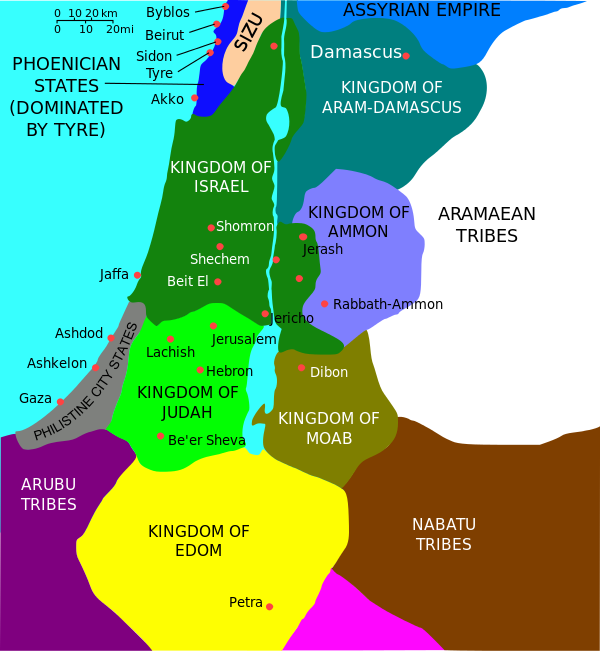
Prior to the consolidation of the kingdom the Hebrew tribes in the hills of Judea were priodically threatened by the coastal seafaring peoples. Biblical references to the Philistines refer to five cities in the coastal plain (Gaza, Ashkelon, Ashdod, Ekron, and Gath).

A map of the Eastern Mediterranean ca. 830 BCE (i.e. about a century after Solomon and the split of the kingdom) indicates the following:


If we think of roads parallel to rivers as signifying peace, and bridges signifying strife, perhaps we can envision roads leading from the seashore to the hills of Judea and Israel as signifying strife. In the wake of the late bronze age collapse, the bible reports, King David triumphed in such strife and managed to unify the hill tribes under one kingdom. But ultimately, what comes of kings? asks Wolf-Pruzan: "they take our horses for chariots, our sons for soldiers, our daughters for widows, and our mothers for grief."

Better to place our faith in God said the rabbis. But how do we commune with God?

Priests in the time of judges communed with God by administering the sacrifices. Consolidation of the tribes under kings marked the end of local control. Local priestly functionaries who presided over sacrificial offerings during the era of Judges, like Eli at Shiloh (1 Samuel), were ushered aside by the kings and a new priestly establishment centered on the temple in Jerusalem. But sacrifice remained central.

The priesthood was not a mystery cult. Animals were brought, and sacrifices were administered per instructions that were public. The role of the priests was not to improvise. It made their role ministerial rather than powerful.

The Ark of the Covenant


Israelite religion in the period preceding the kingdoms is not object centered. Cliff Detz asked what about the ark of the covenant? What was its function during the period of the Judges? It went to war, says Wolf-Pruzan, but it did not play a role in making sacrificial offerings. King David made it important by bringing it to Jerusalem where it was enshrined in the temple.

The Ark of the Covenant is a sacred chest ... that contained the stone tablets of the Ten Commandments, and at one time occupied the holiest shrine in the ancient Temple of Jerusalem.  .... According to Biblical tradition [it] was built in the wilderness of Sinai during the travels of the Hebrews to the Holy Land. Eventually, it was placed in the inner shrine in the Temple of Jerusalem. Both the Ark and its sanctuary were said to be "the beauty of Israel" (Lamentations 2:1), and Zion was consecrated because of its containing the Ark (2 Chronicles 8:11). Some Jewish Midrashim suggest that two Arks existed—a temporary one made by Moses and a later one made by Bezalel (Hertz 1936). In any case, the Ark of the Covenant disappeared (was hidden or destroyed) following the invasion of the Babylonians and their destruction of the first Temple of Jerusalem in 586 B.C.E. Many subsequent myths and legends arose about the Ark's potential whereabouts. 
....The Bible describes the Ark as made of acacia wood. It was a cubit and a half broad and high and two cubits long (about 130 by 80 by 80 cm). The Ark was covered with gold. On each of the two sides were two gold rings, wherein were placed two wooden poles (with a decorative sheathing of gold), to be used to carry the Ark (Numbers 7:9; 10:21; 4:5,19, 20; 1 Kings 8:3, 6). Over the Ark, at each end, were two cherubim, with their faces turned toward one another (Leviticus 16:2; Num. 7:89). Their outspread wings over the top of the ark formed the throne of God, while the ark itself was his footstool (Ex. 25:10-22; 37:1-9). The Ark was deposited in the inner shrine of the Temple of Jerusalem (called the "Holy of Holies)," and was placed so that one end of the carrying poles touched the veil separating the two compartments of the tabernacle (1 Kings 8:8). When carried, the Ark was always wrapped in a veil, in badger skins, a blue cloth, and was carefully concealed, even from the eyes of the Levites (priests) who carried it....
It is referred to as the most holy place (Ex. 26:34)....  The ... high priest would go in, once a year, on ... Yom Kippur, to sprinkle the blood of an animal upon the Ark of the Covenant and the mercy seat which sat on top of the ark. The animal was sacrificed on the Brazen Altar and the blood was carried into the most holy place. It is said that the Lord would appear in the cloud upon the mercy seat, and at that time the priests should not enter into the tabernacle (Leviticus 16:2).....
The only mention of the Ark in the books of the prophets is the reference to it by Jeremiah, who, speaking in the days of Josiah (Jer. 3:16), prophesies a future time when the Ark will no longer be needed because of the righteousness of the people. In the Psalms, the Ark is twice referred to. In Ps. 78:61 its capture by the Philistines is spoken of, and the Ark is called "the strength and glory of God"; and in Ps. 132:8, it is spoken of as "the ark of the strength of the Lord." 
The Ark is mentioned in one passage in ... 2 Maccabees 2:4-10, which contains a reference to a document saying that the prophet Jeremiah, "being warned of God," took the Ark, and the tabernacle, and the altar of incense, and buried them in a cave on Mount Nebo (Deut 34:1), informing those of his followers who wished to find the place that it should remain unknown "until the time that God should gather His people again together, and receive them unto mercy." 
After destruction of the First Temple its importance receded again, only to reemerge as the fetish of the Torah Ark in synagogue practice. 

Hannah as the Way Back to God


With the loss of the temple the ancient manner of engaging with God (the sacrifice administered by the priests) was lost. Not only was the normal on-ramp to the highway of communication with God lost, but the central authority of theocracy under the Kings and the Sanhedrin was lost as well. 

"Next Year in Jerusalem" suggests hope for the ultimate restoration of the universe under God without the need for human intervention. Without the need for government, priestly or secular? That's fine for that utopian time when the Mashiach comes, but in the meantime, in the absence of a central temple, in the absence of sacrifice, in exile without national power, the rabbis needed to devise a new way. How do we commune with God and keep the community together? The rabbis decided to follow Hannah and her direct appeal to God with intimate prayer, despite all of its dangers. 

Direct intimate prayer introduces the danger of radical variation and the loss of cohesive doctrine. The rabbis devised to control this radical ecstatic prayer by setting it loose in a communal setting. Individual prayer yes, but in a communal setting. The way of the rabbis became to influence through exploration, persuasion, and argument, not to control with power. Although rabbis sometimes were empowered by local states, they had no inherent power. For example the chief rabbi of Jerusalem was appointed by the British in order to exert political control. Nevertheless, rabbis have exerted their influence through authoritative structures. Individuals can argue with the rabbis but individuals don't get to set the rules. Just like children argue with parents; they don't get to make the rules. 

Brief Summary of Berakhot 31b (top of p. 210) to Berakhot 32a (first two paragraphs on p. 212)


"And later in her prayer,"... say the rabbis, Hannah said to God "And you will grant Your servant an offspring of men."  [This is reminiscent of the characterization of "impertinence" that the rabbis attributed to Hannah's prayer with the parable of the beggar who crashes the king's banquet (top of p. 209)]  The rabbis in their discussion make a comparison between Hannah's son Samuel and Moses and Aaron. Samuel is an important person because he gets to anoint two kings, Saul and David. 

Some prayer! 

More rules of prayer are derived--don't sit within four cubits of someone in prayer.  [A cubit is the length from elbow to the tip of the middle finger] 

Samuel is presented as the first rabbi. He taught halakhah in the presence of his teachers (which is forbidden). When Hannah and Samuel come to Eli the priest to offer sacrifice to expiate the transgression, they bring the animal already slaughtered.  This is contrary to priestly practice--but consistent with Torah.  Interpretation of Torah is emphasized over the priestly practice. 

Just like the priests improvised on Torah by appropriating the performance of the slaughter of the sacrifice in the past, Hannah improvised with her direct appeal to God in prayer without the sacrifice, and Samuel improvised by exerting influence with his interpretation and teaching of Torah--as the rabbis are doing to this day.

"For this youth I prayed and I want no other...." says Hannah in response to Eli's desire to punish Samuel and Eli's offer to pray for one who is greater. No thank you says Hannah. The rabbis here harken back to Moses' defense of the Israelites before God's anger in the desert--the rabbis are endorsing Samuel's teaching of Torah (even in the presence of the teacher) over Eli's ways and his proposed punishment: the rabbis go with rabbinic interpretation of Torah over the traditions of Eli the priest.

The "next key move," says Rabbi Peretz is to validate this prayer. When she prayed, "Hannah spoke on her heart."  The Hebrew  here suggests to "hurl accusations/throw stones."  The rabbis unpack this, explaining Hannah spoke to God concerning matters of her heart.  Heart (Lev) suggests one's mass, one's physical substance. But Hannah also speaks passionately; the emotion brings in the Nefesh (the systems that pass through our throat--our animus). And, of course prayer involves the intellect. Hannah prays with her heart and soul and intellect.

The rabbis note that Elijah also appealed passionately to God in 1 Kings 18:37 ("Answer me , O Lord, answer me, that this people may know that thou, O Lord, art God, and that thou hast turned their hearts back") How, ask the rabbis, do we know that God conceded to Elijah? Because God answered the request (I assume).  

The rabbis are trying to work out permission to make direct, passionate, appeals to God (with all our body, our animus, and our intellect) says Wolf-Pruzan.  

We do not walk alone, the rabbis suggest at the top of page 212. And they point to Ezekiel 36:26-27 for support: "A new heart I will give you," says God, "and a new spirit I will put within you; and I will take out of your flesh the heart of stone and give you a heart of flesh. And I will place my spirit within you and I will cause you to walk in my statutes and be careful to observe my ordinances." It's what comes from a direct appeal, passionate, and personal, like Hannah's. It's the pathway for our communion with God suggest the rabbis. 

We left off with the second paragraph on top of page 212. The next class at the JCCSF is on February 21, 2016. 

Wednesday, December 9, 2015

Talmud Circle 3: December 6, 2015.... (in which Peretz reconciles Hannah's "Sato" ruse)

After a delayed start with setting up, we got down to work, without a break...and before we knew it, we looked up and it was 12:15 and we got the hook from administration to clear the room for the next event. That seems like a good sign, yes?

What engrossed us so?

Preliminaries


Peretz commented on the paragraph structure of the Steinsaltz edition. Steinsaltz helps us decode the architecture of the commentary. It helps us to decode it and identify transitionary moves. [And we are grateful] For example, if we look at the page of Berakhot 31a, page 61 in the Vilna edition (in Hebrew at the end of the book) we see that pages 204-207 are derived from a single page--without paragraph breaks in the Vilna edition.

The Steinsaltz allows us to read just the English, with or without his fills, to compare the Hebrew and English side by side, if we are able, or to go hard-core and read the Vilna edition in its original form in the back of the book, if we are really able.

We compared reading the six "I might have thought" Tosefta, as spelled out and elaborated by Steinsaltz, and then reading just the bolded language, translated from the Vilna ed [at p. 207 (top)]. This illustrates the poetic, rhythmic meter of the original, which was conducive to memorization and oral transmission. For example, take the first six Tosefta:
I might have that one could pray throughout the entire day; it has already been articulated by Daniel, "And three times..."
I might have thought that this began when he came to exile; it was stated: "as he had done before." 
I might have that one may pray any direction he wishes; the verse states: "facing Jerusalem."
I might have that one may include all at one time; it has already been articulated by David, as it is written: "Evening and morning and noon." (Psalms 55:18)  
I might have that one may make his voice heard in his Amida prayer; it has already been articulated by Hannah, as it is stated: "and her voice could not be heard." (1 Samuel: 1:13) 
I might have that one should request his own needs first, and afterwards recite prayers; it has already been articulated by Solomon; It is stated: "To hear the song and the prayer (1 Kings 8:28) song is prayer; prayer is request, does not speak matters of request after emet vyaotziv but after the Amidah prayer even the equivalent of the order of the confession of Yom Kippur recite.
The language is elegantly compact.

Tosefta: refers to "another gathered material." It is additional halakhic or aggadic material not included in the Mishna of Judah Hanassi (b. ~135 CE - d. 217 CE), but created and gathered in the same general community, and shortly after the Mishna. Tosefta follows the order of Mishna. It is also gathered in a separate volume (about three times larger than the Mishna).  Tosefta begin to appear right after acceptance of Judah Hanassi's Mishna. [There are also "Tosefta" that appear after Rashi's (b. 1040-d. 1105, Troyes France) commentaries]

Mishna was redacted after the Bar Kokhba revolt (132-135 CE), perhaps in Zippori, in the Galilee. Zippori was "the Corte Madera" of Judea in the 2nd century. The town assumed enormous importance as a centre of Jewish learning. Rabbi Judah Hanassi and a host of rabbis, students and Jewish academies settled there in the second Century. During this time the city rapidly expanded and might have numbered about 12,000 people. The city was named after the Hebrew word for bird, 'zippor', because birds seemed to soar above its position on top of a hill. Also, birds flew over Zippori on their migratory route. [See CNN Report: "on the superhighway of bird migratory routes"]  King Herod liked the strategic position of Zippori and made it his capital when he was governor of Galilee in the beginning of his career.

Zippori
Zippori Residence mosaic

Zippori Synagogue floor


Tosefta goes deeper than Mishna. It looks for independent access to God through prayer--without intermediaries, in both the public and private spheres.

Aside 1: By the time Hanassi redacted the Mishna many Greeks and other non-Jews lived in Judea and the Galilee, and Jews were a minority. Rabbi Hanassi sought to provide access to the tradition to the Jewish people, who were now dispersed. The rabbis were supported in Zippori because the community recognized the communal value of the work being done.

Aside 2: Philip Alexander (in this BBC 4 "In Our Time" podcast) points out that by the edict of Caracalla in 212,  Roman citizenship was conferred on all free citizens within the empire.  During the last five years of his life, Rabbi Hanassi, therefore, along with the other rabbis working on the Mishna project were Roman citizens. It is interesting to note that at the same time that Judah Hanassi was working on the Mishna there was a similar early codification effort of Roman law under way at the School of Beirut.  [This BBC program on the Talmud is good, and I recommend the podcast series in general]

Aside 3: The first book (of many) written by Moses Maimonedes (b. 1135-d. 1204) was a commentary on the Mishna.  He meant his book to be a guide. It established his credentials.

Aside 4: The Babylonian Talmud was closed as the economy in the Sassinian Empire declined and the Yeshiva culture in Babylon dried up along with it. See Ellis Rifkin: The Shaping of Jewish History: a Radical new Interpretation, which provides a concise history of the Jewish people through the lens of economics.

Aside 5: The Babylonian Talmud contains lots of practical tort laws, laws regarding the ownership of property, laws regarding cattle and damages. There are comprehensive treatises regarding our dealing with others; with minutia like what do we do when a satrap (Persian official) enters the synagogue--do we rise, or keep sitting? Answer: we coordinate our rising with some part of the liturgy that would also cause us to rise.

Aside 6: Where to place the menorah? Traditional rule is near the front gate, so all can see it. By Rashi--and the crusades--the rule is modified that the menorah can be safely lit in the kitchen.  [An exception for safety in an age of dangerous pogroms] One of the articulations of the dream of Zionism early on was to have our own land so we can put the menorah back out in front of the house once again.

Aside 7: A hazzan (or Chazzan) came up in the tradition as "musicians." Professional cantorial role is more recent. Chazzanut  is a composer.  A Cantor has musical skills.

Aside 8: The purpose of the rabbis in writing the Talmud is not for it to rule the synagogue. Talmud is part of it. The goal is to create something attractive so the community wants to stay together. In this sense, the text recreates the Jewish people in the post-temple period.

A Close Reading of Berakhot 31a, 31b (pp. 207-209):


The Tsofeta at the top of p. 207 starts with a reference to the book of Daniel. The book of Daniel was the "best-seller" for all of the 1st century. Its six stories and four dream sequences were known to all. "It is the first great work of apocalyptic writing" [New Oxford annotated Bible]

Daniel is a problematic text for Judaism. It contains reference to "the Father, the Son, and the Holy Ghost." There is the immediate expectancy of a savior--thus, Roman citizenship notwithstanding--it was popular during the Roman occupation. There is reference to the "hoary old man" and the "Son-of-man." [The rabbis claim the term "son-of-man" is a claim to divinity] Jesus speaks a lot about the book of Daniel.  So for all these reasons, Daniel is the last book you would study in a Yeshiva, even as it might be the first book you study in a seminary.  Yet none of this reduced its popularity. Here it is in the Tosefta: "additional halakhot were derived from Daniel's prayer."

Note that the rabbis here incorporate a broad spectrum of bibilical sources. They are building the foundation for the written tradition.

From Daniel's prayer we derive that we pray three times a day, kneeling, and facing Jerusalem.

From Psalms we learn that the three prayers are distributed: evening, and morning, and noon.

From 1 Samuel we learn that the Amida prayer is spoken in the heart only, although we enunciate with our lips.

From 1 Kings we learn the structure of the Amidah: we give praise--then make our personal request--and then give thanks.

There is a reference to confessions, as in the Viduy (end of life) prayers: when we confess, the Hebrew word is closer to "miss" than to "sin" as we might understand it in a Christian reference. Rav Hammauna added that from Hannah's prayer in 1 Samuel we also learn that one must focus one's heart in prayer. The daily Viduy is said "as if it were the last day of your life."  It demands intentionality. Soberness--both literally and metaphorically.

Intentionality of prayer is more important than command of words or the prayer book.

Aside 9:  Hannah is, of course, pre-Davidic. She is on the lowest rung of the social ladder. Her story, barrenness, is a common story of heartbreak. She has everyday troubles. She is imprisoned without children in a multi-wives household. Yet, she is able to approach God directly.

The rabbis in Talmud set up a systems of permissions for access to God.  Even though the temple has been destroyed, Talmud creates on-ramps to the highway of communication with God--another way outside the temple offering system.

Ruth White raised the issue of prayer with a minyan. The Wiki entry for minyan contains the following:
It was the firm belief of the sages that wherever ten Israelites are assembled, either for worship or for the study of the Law, the Divine Presence dwells among them. ...[S]tress is put upon the merits and sacredness of the minyan of ten.  [Maimonides and] the author of the Shulkhan Arukh, have ... made the daily attendance at public worship, morning and evening, to be conducted in a quorum of ten. There is a disagreement between the medieval commentators on whether prayer with a minyan is preferable or obligatory. Rashi is of the view that an individual is obligated to pray with a minyan, while Nahmanides holds that only if ten adult males are present are they obliged to recite their prayer together, but an individual is not required to seek out a minyan. 
Lorraine Harris raised the question, does God answer prayer?  We observed that Hannah's prayer was indeed answered. But was it correlation or causation? For Eli (the priest) or Elkanah (her husband) it's hard to tell. They don't know the nature of Hannah's prayer. Hannah's prayer was silent.  It's hard to say whether any change in fortune is the result of prayer, or not.

1 Samuel seems clear: there was divine intervention in the birth of Samuel. Same was true for Sarah and Abraham and Isaac.  However, the rabbis were aware that (1) prayers often/usually are not answered [for hundreds of years they inserted the prayer for the restoration of Jerusalem into the liturgy knowing it was not happening], and (2) they knew there was an epistemological problem: not only did Elkanah and Eli have no way of knowing the content of Hannah's prayer, or its efficacy--neither could Hannah know if it was her prayer, or something else! She petitioned God for a male child, and Eli blessed her--but how can Hannah know if the pregnancy was due to God's intervention?  Noone narrates our stories in Talmud--how could we know?

Aside 10: Temple priests did not have a spoken role.

A joke: a Jewish mother takes her son to the beach. Suddenly a big wave grabs the boy and sweeps him out to sea. The mother is shocked. She can't believe her eyes; she's always so careful. It can't be! What will her husband say? How could she be so careless!  Then she gets angry.  "God!" she says. "I've kept all your commandments: I keep a kosher kitchen. My husband prays every evening, morning, and noon. We go to Shul. After all we've done for you... how can you do this to me?" And suddenly another big wave delivers her son back to her.  The mother is so relieved. She looks up. "He had a hat ...!"

Correlation or causation? How can the mother know? How can any of us know? Prayers are like that. And the rabbis knew it.

So the rabbis also drew more simple lessons from Hannah.  Rabbi Elazar noted the importance of correcting another who is unseemly in conduct or matter; and if accused in error, you must point this out.

Aside 11: God-Torah-Israel (Heschel):
Judaism is a complex structure. It can be characterized exclusively neither as a theological doctrine nor as a way of living according to the Law nor as a community. A religious Jew is a person committed to God, to his concern and teaching (Torah), who lives as part of a covenant community (Israel).

Judaism revolves around three sacred entities: God, Torah, Israel. The Jew never stands alone before God; the Torah and Israel are always with him.

God as an isolated concept may be exceedingly hidden, vague, and general. In Jewish experience the relation between God and man is established as a concrete and genuine situation in finding an answer to the questions: What are the acts and moments in which God becomes manifest to man? What are the acts and moments in which man becomes attached to God? To the Jew, the Torah is the answer. ... [It] is not only the adherence to particular doctrines and observances but primarily the living in the spiritual order of the Jewish people, the living in the Jews of the past and with the Jews of the present. Not only is it a certain quality in the souls of the individuals but it is primarily involvement and participation in the covenant and community of Israel. .... 
A. Torah  
The Torah, the comprehensive name for the revealed teachings of Judaism, has been an object of love and adoration. ... [T]he Torah has a concrete as well as a spiritual reality; it not only exists as a book in human possession; it also exists in heaven as well as on earth. Indeed, the Hebrew term for revelation is literally "Torah from heaven." ....
The world was created on approval. Unless the Torah was accepted at Sinai, the cosmos would have to be returned to chaos. There could be a cosmos only with the Torah. The absence of the Torah would imply the absence of the universe. With Torah comes the divine blessing of an ordered creation. Without it, there is danger of a return to the abyss of cosmic confusion. The Torah is the ground of all beings. The creatures of heaven and earth cannot exist without it. [citing Babylonian Talmud:  Avoda Zarah, 3b; and Sanhedrin 99b].... 
B. God 
[And....] One must always live in the awe of God (Deuteronomy 6:13). .... One should be in awe of God while in the sanctuary. One's awe should be directed to God, not to the sanctuary."  ... 
The Torah is not to be understood in its own terms. Love of the Torah and awe of God are interrelated. Acts of loving-kindness and study of Torah must go together....
The Torah does not stand alone. It stands with God and with man. Love of Torah links awe of God with the individual performance of deeds of loving- kindness toward one's fellow men. The Torah is the knot wherein God and man are interlaced. However, he who accepts God's existence without accepting the authority of the Torah deviates from Judaism..... 
C. Israel 
Israel is the wick, the Torah the thread, and God's presence (Shekinah) is the fire. [Citing Tikunai Zohar, 421, 60b] ... 
These are three entities, each of which is connected to the other: God, the Torah, and Israel. "God and Israel, when together, are called one, but not when' parted."57 Similarly, "when a man separates himself from the Torah, he separates himself from God." [Citing Zohar, Vayikra 21a]... 
You are my witnesses, says the Lord, and I am God (Isaiah 43:12). Rabbi Simon ben Yohai (second century) took the sentence to mean: If you are my witnesses, I am God; if you cease to be my witnesses, I am not God.76 This is a bold expression of the interdependence of God and Israel, a thought that occurs in various degrees of clarity in the history of Jewish theology. This particular statement maintains: If there are no witnesses, there is no God to be met. There is a mystery, an enigma, a darkness past finding out. For God to be present there have to be witnesses. [citing Seder Elija Rabba, ch. 21] The essence of Judaism is the awareness of the reciprocity of God and man, of man's togetherness with Him who abides in eternal otherness. For the task of living is His and ours, and so is the responsibility. We have rights, not only obligations; our ultimate commitment is our ultimate privilege..... 
God is now in need of man, because He freely made him a partner in his enterprise, "a partner in the work of creation." "From the first day of creation the Holy One, blessed be He, longed to enter into partnership with the terrestrial world" to dwell with his creatures within the terrestrial world.80 Expounding the verse in Genesis 17:1, the Midrash remarked: "In the view of Rabbi Johanan we need His honor; in the view of Rabbi Simeon ben Lakish He needs our honor." [Citing Genesis Rabba, ch. 30] ....
Jewish existence is not only the adherence to particular doctrines and observances but primarily the living in the spiritual order of the Jewish people, the living in the Jews of the past and with the Jews of the present. It is not only a certain quality in the souls of the individuals; it is primarily involvement and participation in the covenant and community of Israel. ....  Our share in holiness we acquire by living within the community. What we do as individuals may be a trivial episode; what we attain as Israel causes us to grow into the infinite.
Rabbi Elazar noted that one who prays drunk is undertaking a "useless activity." The Steinsaltz translators rendered this as "idol worship," but the more accurate rendering, said Rabbi Peretz, is "useless activity."  This implies, I suppose that praying drunk is allowed--just don't expect it to be efficacious. But then... since our sober prayers are often not efficacious either [and, as noted, how can we ever know?] .... what the heck. As Leonard Cohen sang: "Like a drunk in midnight choir, I have tried in my way to be free!" [By the way, have you read Bernard Avishai's great piece in the New Yorker "Leonard Cohen's Montreal?"]

Yet in 1 Samuel, there did seem to be some rebuke in Eli's comment: "How long will you be drunken? Put away your wine from you." 1 Samuel 1:14. And Hannah was defensive about it. Id. 1:17.  It seems likely that Rabbi Elazar did not intend "useless activity," but something more morally loaded. Perhaps that is why the translators went with "idol worship," even if this is not a perfect word choice.

Aside 12: Hannah referred to God as "the Lord of Hosts." Rabbi Elazar notes "this is a first." The root word here suggests "spheres", the "Lord of the spheres," "the Lord of all the expanding spheres."  The word  "hosts" means multitudes:  multitude of spheres.

Aside 13: The word melech (angel) meant emanations between us and God that we can perceive. There was no connotation of "wingy-things." However in that problematic, but popular book, Daniel, they are wingy-things. In Ezekiel too.

The parable of the poor person asking for bread of the king at a banquet: "give me a piece of bread," and "from this entire feast... is it so difficult in your eyes to give me a single slice of bread?" The rabbis here allude to a petitioning prayer as pushy..., not a passive request.

The Sato fantasy [See p. 209, or the last blogpost, for the play by play]: the rabbis here fully realize that this is an absurd thought experiment. Elazar's opinion is that if Hannah conceives in response to her prayer, even if we knew the content of her prayer--which we cannot know--we cannot know if we are looking at mere correlation or causation. ["As it is taught in a baraita that the tanna'im disputed the interpretation"] Why did they dispute it? Because we cannot know. And if we could, as Rabbi Akiva said, "all barren women will go and seclude themselves with men"... and practice this Sato ruse on God... and that's pretty silly. According to Rabbi Akiva's explanation, say the rabbis (third para. from bottom, p. 209) "The Torah spoke in the language of men, meaning ... nothing may be derived from it." In other words, the rabbis are working hard to downplay the miraculous; they are working to avoid attributing a hoped for response to prayer (a correlation) to the miraculous.

The rabbis were cautious about creating systematic miracles.

So what does this tell us about prayer: we should have deep introspection without an expectation of reward.  For prayer to be truly holy it must be made non-utilitarian.

When we say Kodesh in public prayer (e.g. "may all those in need of healing be healed") the requests are always non-specific.

Rabbi Yosei, at bottom of p. 209, notes that Hannah attests to her status as God's servant in her prayer. Her attitude is the opposite of the cocky, impudent, poor person barging into the king's feast.

We left off at the bottom of p. 209.


Tuesday, November 3, 2015

Talmud Circle 2: November 1, 2015

Hannah's despair, Ilja Repin (1844-1930)

Some Definitional Terms--Sources:


Tannaim:  Tanna is an Aramaic word related to Hebrew "Shana", meaning to "repeat" or "recite." The Tannaim, thus, were those who repeated and recited the Torah and passed it down through the generations.


The Mishnah:  The first major book of Rabbinic literature, or redaction of the oral law. Mishnah is organized by six subject matters (Seeds-Agriculture;  Times--Sabbath & Holidays; Women--marriage & divorce; Damages--Civil & Criminal law; Holy Things--Ritual & Temple; and Rituals--rituals of purification) The authoritative collection of Mishnah is by rabbi Judah HaNasi. [Note: "Blessings" are included in Seeds].

Barita: Tannatic teachings that were not included in Mishnah.

Talmud: First layer of Talmud is Mishna; but not every Mishna is in the Talmud--only the ones Rabbis talked about or felt important.  Talmud is the Gemara as it comments on Mishna--but not every Mishna.  Talmud follows the flow of the Mishna.  Same organization. Also includes  some Midrash. 

Amora: Means "speaker:" refers to the rabbis in the fourth/fifth centuries who spoke about the Torah and the Mishna.

Midrash: Comments organized by Torah portion.  Also contained in a separate collection. The Madrash Rabba. Some Midrash is also included in Talmud. 

Brief Review: 


Torah portion is Samuel 1 about Elkanah and his two wives--Hannah and Peninnah. Hannah was childless and petitions the Lord with prayer. We're at Shiloh, North Central Israel, before Israel's three kings [Saul-David-Solomon]. 
The Tabernacle at Shiloh?/NW Encyclopedia
Key transitional times. Israelites in the hills were late bronze age people. There is evidence the Philistines on the coast were an early iron age people. Some people interpret the David and Goliath story as a contest between these bronze age and iron age powers: David overcame the iron age power with guile and cleverness. But he also stole their ironworkers. 

The traditional offering to God is the sacrifice. The family would go to Shiloh every year to bring their offering. "On the day when Elkanah sacrificed, he would give portions to [his family]." Samuel 1:4.  

Traditional prayer: the fire consumes the flesh; part of the offering goes up to the heavens as ash and heat rise; represents earth/wind/fire. It's a recycling of life: form is lost along with the illusion that you once owned form.  As the portion is consumed it turns into matter, heat, and air. The sacrifice is a transformation of the offering. [It's mindfulness; no wonder many Jews have been drawn to Eastern religions that practice mindfulness] [Christ as the "Lamb of God"] 

You don't need language or a building to practice sacrifice. But you did need to be in Israel. The law of sacrifice is only binding in the land of Israel [because that's what Torah says] The sacrificial cult cannot be exported; you can't conquer other lands in its name. The religion as practiced was local--even though God was conceived as universal. The Lord of Hosts. After destruction of the Temple, there was a transfer from the land to Torah: we are bound to Torah as we were bound to the land.

Asides:


Aside 1: Cliff Detz thinks Israelites were not yet monotheistic when Hannah prayed at Shiloh. Peretz pointed out that the story of Hannah takes place pre-Judaism.


Aside 2: Peretz referred to Abraham Joshua Heschel's work and his conception of Judaism as a religion of time. His Sabbath: Its Meaning for modern Man (1951) "is a work on the nature and celebration of Shabbat( and) is rooted in the thesis that Judaism is a religion of time, not space, and that the Sabbath symbolizes the sanctification of time."

Aside 3: Hasidism, Zionism, and Reform Judaism all have the same birth date. They all responded to a crisis in Judaism; it's practice had become dull and formulaic. Uninspiring. Jews had a hard time getting a minion together in Germany. 

Aside 4:  Zionism said "if we just till the land, isn't that enough?" They felt it was enough to just be on the land. Connected with Martin Buber's Hebrew Humanism. Martin Buber (1878-1965).  From the Stanford Encyclopedia of Philosophy
Martin Buber, ~1900(?)
Buber was recruited by … Herzl to edit the main paper of the Zionist party, Die Welt. He soon found a more congenial home in the “democratic faction” of “cultural Zionists” led by Chaim Weizmann, then living in Zurich. …[H]e never ceased to write and speak about what he understood to be the distinctive Jewish brand of nationalism. …He … search(ed) for psychologically sound foundations on which to heal the rift between modern realpolitik and a distinctively Jewish theological-political tradition. Very much in keeping with the nineteenth-century Protestant yearning for a Christian foundation of the nation-state, Buber sought a healing source in the integrating powers of religious experience. …[H]e … began publishing the journal Der Jude, which served as an open forum of exchange on any issues related to cultural and political Zionism. In 1921 Buber attended the Zionist Congress in Carlsbad as a delegate of the socialist Hashomer Hatzair (“the young guard”). In the debates that followed the first anti-Zionist riots in Palestine, Buber joined the Brit Shalom, which argued for peaceful means of resistance. During the Arab revolt of 1936–39, when the British government imposed quotas on immigration to Palestine, Buber argued for demographic parity rather than trying to achieve a Jewish majority. Finally, in the wake of the Biltmore Conference, Buber (as a member of Ihud) argued for a bi-national rather than a Jewish state in Palestine. At any of these stages Buber harbored no illusion about the chances of his political views to sway the majority but he believed that it was important to articulate the moral truth as one saw it. Needless to say, this politics of authenticity made him few friends among the members of the Zionist establishment.

At the theoretical core of the Zionism advanced by Buber was a conception of Jewish identity being neither a religious nor a national form, but a unique hybrid. ... Buber rejected any state-form for the Jewish people in Palestine. .... Buber embraced Zionism as the self-expression of a particular Jewish collective that could be realized only in its own land, on its soil, and in its language. The modern state, its means and symbols, however, were not genuinely connected to this vision of a Jewish renaissance. While in the writings of the early war years, Buber had characterized the Jews as an oriental type in perpetual motion, in his later writings the Jews represent no type at all. Neither nation nor creed, they uncannily combine what he called national and spiritual elements. 
In his letter to Ghandi, Buber insisted on the spatial orientation of Jewish existence and defended the Zionist cause against the critic who saw in it only a form of colonialism. For Buber, space was a necessary but insufficient material condition for the creation of culture based on dialogue. A Gesamtkunstwerk in its own right, the Zionist project was to epitomize the life of dialogue by drawing the two resident nations of Palestine into a perfectible common space free from mutual domination.

A Buber anecdote: "an aged pious man, Rabbi Susya, became fearful as death drew near. His friends chided him, 'What! Are you afraid that you'll be reproached that you weren't Moses?' 'No,' the rabbi replied, 'that I was not Susya.'"


Aside 5:  O.K., I read the Judith Hauptman article on women and prayer. I confess, I scanned this and did not try to follow all her minutia--because, frankly, I don't need to be convinced that women are equal to men, including in the ability/obligation to pray.  The article doesn't mention Hannah or Samuel 1.  So what's all that about?  I also listened to the Dov Hartman video.  She's quite the gal; she does speak about Hannah and tells us what Peretz said. 

Aside 6: There are (of course) folks advocating for rebuilding of Third Temple NOW. And, of course, there is textual support for this.  E.g. two of the seven blessings of the wedding ceremony--Sheva Berakhot-- talk about the ingathering in Jerusalem and "let there soon be heard the sounds of joy"; soon as in tomorrow.  People skip stuff they don't like in the blessings; but people read that stuff and take it seriously--so we need to engage with it to fight the good fight. 

Aside 7: When the temple was built, the priests tried to stamp out the ritual practice at the sacrificial mounts throughout the land. Priests wanted to control the sacrifice centered on the Temple. Crowds who arrived in Jerusalem from other places needed to change money into local currency.  Currencies proliferated.  Money changers set up tables outside the temple. They charged 4-8% premium on the exchange.  Among other things, there was a thriving market in selling of sacrificial animals. 

Aside 8: There is a thin line between offering and magic. Offering needs to be brought for the "right" reasons. 

Aside 9:  Cohen means "servant of the place."  The Cohens were the custodians of the temple. They were not allowed to leave the building. Not a power group; but a burdened and restricted group. 

Aside 10: Jaffa was the early location of the Jewish poets.  Herzel  built his Yeshiva in Jaffa. He had no interest in Jerusalem. 

Aside 11: At engagement party tradition is to break a plate. Symbolism is that although we exported Judaism into diaspora, it is unstable, impermanent, uncertain. 


Back to Hannah at Shiloh: 


Traditional prayer was not doing it for Hannah. Year after year, Hannah did not become pregnant. "Therefore Hannah wept and would not eat [of the sacrificial offering]."  Samuel 1:7 And then Hannah made a revolutionary move: Hannah went to the priest (Eli) alone and prayed silently, petitioning God directly without priestly intervention, and without a sacrificial offering being involved. 1:10. She's been "pouring out her soul before the Lord" (1:15) and Eli blessed her.  And her prayers were answered. 

This pre-temple period was full of religious variety: there was much more than just Pharasees, Saducees, and Essenes.  

Recital of Shema (morning & evening) is linked to when priests would consume their Truma (tithe). The Shema replaced the sacrificial offering in post-temple times. This was a major move from the concrete to the symbolic.

Talmud:  Berakhot 30b, 31a


So how do we pray?


First Mishna: One may only stand and begin to pray from an approach of gravity and with submission--some have prepared for an hour beforehand--in way not to be distracted by high (kings) or low (snakes). 
Halakhah: How many ways to walk, how many ways to go do we learn from this Talmudic portion?  
Prophetic religion was critical of the rote nature of sacrifice. Sacrifice as method. Prayer must be more mindful. Method of sacrifice vs. mindfulness of prayer.  
Hannah's approach to God is different from the method of sacrifice in that her prayer is heartfelt.  
Must enter the temple with awe. There is a focus on imminence. [There is no word in Hebrew for "prayer" as such. The word "Bevahkasha" is used and it means to request.  "Haleot" is used and it means praises. "Brachot" is used and it implies a radical centeredness]
Here is my paraphrase of the Gemara found on pp. 203-209): 
They say from Hannah we derive a requirement to approach prayer with gravity.
Hannah was also bitter, but bitterness is rejected. Rabbi Yosei says the key is to approach "reverently," citing David in Psalms. Nope, says Rabbi Yehoshua ben Levi: we should approach in "trembling of holiness;" one must enter into prayer from an atmosphere of "gravity engendered by sanctity."  
No, that's not quite it either, says the Gemara. We note that Rav Yehuda would adorn himself to pray, suggesting,  perhaps "it's in the beauty." 
But Rav Nahman bar Yitzhak said "Serve the Lord in fear and rejoice in trembling."  Rav Adda bar Mattana said this means there must not be unbridled joy. "Where there is rejoicing, there should be trembling," he said. Abaye is rebuked for being excessively joyful.  And Abaye said: "but I'm wearing philacteries! As long as I wear them, they ensure that the fear of God is upon me."  O.K. then. 
Yes, sorrow is appropriate, but not excessive joy, agreed Rabbi Zeira. "In all sorrow there is profit," he says.  "But I'm wearing phylacteries!" says Rabbi Yirmeya. 
A story:
Rabbi Ravina thought people were excessively joyous at his son's wedding, so he smashed a cup worth four hundred zuz (~$750/with silver at $15 per ounce). Rabbi Rav Ashi, at his son's wedding, did Rabbi Ravina one better and smashed "a cup of extremely valuable white glass." And the wedding guests "became sad." 
And, when the sages suggested the master sing a song at his son's wedding?  Well, he said, a tad overreacting perhaps: "Woe unto us, for we shall die! Where is Torah and mitzvah to protect us?"  
Rabbi Yohanan, another serious fellow, said "One is forbidden to fill his mouth with mirth in this world as long as we are in exile!"  Are we in exile still?
Halakhah:
It is not appropriate to pray when halakhah is in doubt "as preoccupation with the halakhic ruling will distract us from prayer."  But what is an example of conclusive halakhah?   
I know one, said  Abaye: "Rabbi Zeira had a halakhah--the daughters of Israel were stringent with themselves; to the extent that they saw even a drop of blood corresponding to mustards seed, they sat seven days clean for it!" [This exceeded the requirements of Torah] "I have one too," said Rava, referring to the exemption from tithing a portion of grain fed to animals if it has not been threshed and piled. Or, consider the prohibition on making beneficial use of the blood of a sacrificial animal! 
O.K., said the sages. "That settles that; we'll pray with an atmosphere of gravity!"  It's a conclusive halakhah. 
So.... on topic of proper preparation for prayer: Sages taught we may not stand to pray from an atmosphere of sorrow, laziness, laughter, conversation, frivolity, or purposelessness. One should approach prayer from an atmosphere of "joy of mitzvah." [Just make sure it's not excessive joy!] 
When we talk of halakah we should also take leave of one another in the same frame of mind as we approach prayer. We should conclude our talks with words of praise and consolation. [Because, heaven knows, we do get contentious!] 
As Mari taught: we should take leave of another in a way they will think well of us and the new halakhah they learned. You know, like that time Rav Kahana and Rav Shimi bar Ashi went to the palm grove of Babylon and Shimi bar Ashi taught that the palm trees of Babylon date back to Adam. Or that time when the student Rav Mordekhai accompanied his master Rav Shimi bar Ashi all the way to Keifei; or was it Be Dura?
 But back to prayer:
In the Tosefta (supplement to the Mishna) the sages taught that one who prays must focus his heart toward Heaven. If God directs your heart, his ears will listen. And in a baraita it says Rabbi Akiva would shorten his prayer with the congregation, so as not to be an encumbrance on them, but when he prayed alone his enthusiasm was so great that he'd go on, and on, and on, and would unwittingly move from one corner to another. 
Rabbi Hiyya bar Abba said: "we should always pray in a house with windows" because, after all, Daniel had open windows in his attic where he prayed three times a day upon his knees--and these windows faced Jerusalem.  And did you hear that?  Three times, Daniel prayed. So it is halakhah.  And not just in Babylonian exile did he do that, but he did it before. And did he face Jerusalem?  It's not coincidence; its halakhah. And David said "morning, noon, and night I pray aloud and He hears my voice." If it's good enough for David, it's good enough for us... it's halakhah. The Amidah (the central prayer in every worship service) we recite without making our voices heard; because Hannah...its halakhah. And the order of prayer is praise, then petition, then thanks; that's how Solomon blessed the temple... it's halakhah. 
After the Amidah prayer there is no limit. We may recite the equivalent of the order of the confession on Yom Kippur... it's allowed. It's true: the Amora of Rav Hiyya bar Ashi agrees--if you have additional requests after completing the Amidah, knock yourself out. 
How many halakhot can be derived from the prayer of Hanna? wondered Rav Hammuna. Well... focus your heart, enunciate the words, not only contemplate them in the heart, but we must recite silently. And we must not be drunk. In fact we must remove the wine from ourselves. It's halakhah. 
And continuing with Berakhot, 31b:
And Rabbi Elazar said "if you see someone praying in an unseemly way, reprimand him or her. Go set them straight. It's a mitzvah."
What about Eli falsely accusing Hannah of being drunk? Well, there is a dispute.  Rabbi Hanina says it means the divine spirit did not rest upon Eli in his judgment. In other words, it's a mistake; it happens.  On the other hand Rabbi Elazar says this is the foundation for the halkhah that one who is wrongfully suspected of something must come forward and inform the one who wrongfully suspects, and clear himself or herself of suspicion.  We have a duty not to sulk in silence. 
Rabbi Elazar also concluded that praying drunk is like idol worship. Don't do it. [Say what?Yeah, there is a note; don't ask]  But if you're wrong in your accusation, you had better appease the one you accused falsely, and bless him or her... it's halakhah.  [After all you've greatly annoyed the falsely accused]
Then there's a parable.  Whoa, or as Eli might have said, we're not at Shiloh anymore Sherlock:
Rabbi Elazar says, "did you hear that? Hannah called God 'The Lord of Hosts!' Nobody does that."  Moreover, Hannah taunts the Lord: "Is it so difficult for you to grant me one son?" she says. 
The Gemara says this is like a street person crashing the king's feast and standing at the door saying to guests: "give me a peace of bread." When he's ignored he pushes his way up to the king and says: ""is it so difficult for you to spare me a single peace of bread, huh?" Hmmm.
Well, the Gemara here rather misrepresents Samuel 1.  There is nothing in Samuel 1 that would suggest the petulant attitude that the rabbis attribute to Hannah here. It's not at all clear, in fact, that the rabbis had their Samuel 1 handy.  Hannah pours out her soul before God and gets straight to the point: "She prayed to the Lord and wept bitterly. And she vowed a vow and said 'O'Lord of hosts, if thou wilt indeed look on the affliction of thy maidservant...[I will consecrate my son to you]" Samuel 1:10-11. There is nothing here about "give me!" or "You owe it to me" as the rabbis suggests. Nothing petulant at all, in fact.

But the Talmud story goes on:
What was Hannah threatening? I will go and seclude myself with a man, so my husband suspects adultery, and they will have to give me the Sato. [Sato is a trial by ordeal involving public humiliation, and drinking of water contaminated with a scroll that contains the woman's denial of adultery--ending in her belly swelling and her thighs falling away if she's guilty, or (if she's innocent) a priestly declaration of "never mind you can go back to your husband now." As if she'd want to] And because it will be a ruse in Hannah's case, and she did not commit adultery, God will have to let her pass the trial by ordeal. And she will bear children because Torah says if you pass this trial by ordeal "you shall conceive." 
Well, the rabbis who thought up that particular fantasy had spent a bit too much time in the library and away from their women.  Really!

I think I will stop here and let Peretz clear this story up for us on December 6.

Happy reading to all,

Roland Nikles